



A rather lackluster performance at Breese Stevens Field in Madison, Wisconsin, sent Portland Hearts of Pine home after a brace by Ryan Carmichael.
The Boys From Maine looked discombobulated early on, conceding in just the fifth minute after Kash Oladapo was unable to push a ball out of play or back upfield, giving Madison a cut-and-dry opportunity from a yard out.
The first half was mostly more of the same, with a couple nice moments in possession from Michel Poon-Angeron and an important save in the 30th from Oladapo. The best opportunity would come from Abu Camara in the 25th minute, but he couldn't quite make use of Poon-Angeron's line-breaking pass as his shot was blocked. Hearts of Pine would go on to concede 14 shots in the first 45.
The second half was better; a little more urgent. Diego Gonzalez nearly found his 11th goal on the season in all competitions after firing what seemed to be a perfect free kick in the 50th minute, only to be incredibly saved by goalkeeper JT Harms.
That would prove to be Hearts' best chance of the game, though they did enjoy a bit of attacking danger through the opening period of the second half. The later the match drew on, the more opportunities Madison would continue to find: A 60th minute free kick that was inches away, an offside call eight minutes later, a very-near 'Oopsie!' giveaway in front of goal in the 85th minute, among others.
There's a lot to get into, so let's talk timeline and tactics.
Lineup
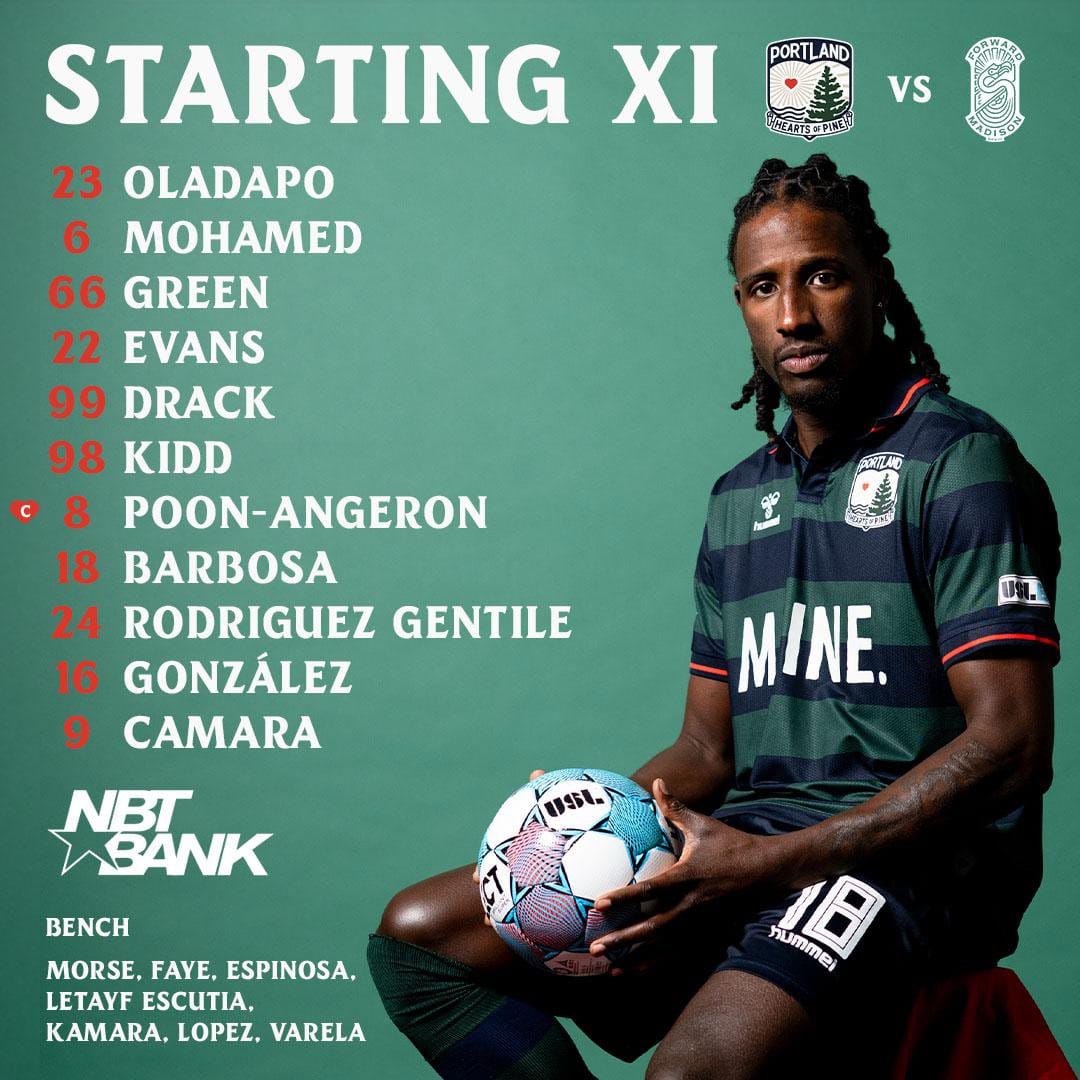
Portland's final away trip of the season had a fresh-look lineup, partially pure rotation, partially forced by injuries. Kash Oladapo made his first start since May 6th (away at Fort Wayne FC) and his third of the regular season.
Michel Poon-Angeron – making his first start since returning from international duty with Trinidad and Tobago – and Diogo Barbosa round out the changes from last week's outing against AC Boise, replacing Diego Letayf Escutia and Jay Tee Kamara.
Timeline
5' MAD 1-0 POR: Goal. Oladapo attempts to make a save after a Diogo Barbosa turnover, but it deflects off his leg toward the net and finds Carmichael for a tap-in.
25' MAD 1-0 POR: Chance! Michel Poon-Angeron plays a great vertical ball into Abu Camara at pace just outside the 18-yard box. He takes a touch to set up, but his window of opportunity was closed as Madison block the shot.
30' MAD 1-0 POR: SAVE! Ryan Carmichael floats into the space between Evans and Green. He redirects the ball to the far post with a header, but Oladapo makes a flying save to push it wide!
33' MAD 1-0 POR: Save! Oladapo is wide awake to an opportunity at the top of his box, grabbing the ball away from goal before any damage could be done.
36' MAD 1-0 POR: Scrum! On service into the box, Forward Madison falls on top of Mo Mohamed then pushes at him as they got up. Several players gather together, but all manage to avoid bookings.
38' MAD 1-0 POR: Penalty. Josh Drack pushes a Madison player down in the box. The referee shows him a yellow.
40' MAD 2-0 POR: Goal. Oladapo gets a foot to the ball while going the other way, but it wasn't enough to keep Carmichael's penalty out of the net.
46' MAD 2-0 POR: Sub. Mbacke Faye in for Camara.
50' MAD 2-0 POR: Chance! Gonzalez hits a looping free kick perfectly aimed inside the top right corner. Madison's keeper does everything they can to reach it on time to keep it out. It's the best chance of the game for Portland.
60' MAD 2-0 POR: Danger! Mbacke Faye earns a yellow just outside the box after committing a foul. Madison's Ryan Carmichael takes the ensuing free kick, deflecting off Matteo Kidd, who got in the way. The ball goes only just wide of Oladapo's right post.
66' MAD 2-0 POR: Subs. Kamara and Varela in for Gonzalez and Barbosa.
67' MAD 2-0 POR: Chance! Rodriguez Gentile can't quite get clean contact off a cross into the box as his shot goes just wide of the far post.
82' MAD 2-0 POR: Sub. Lopez in for Poon-Angeron.
85' MAD 2-0 POR: Danger! Oladapo takes a long touch inside his own box, nearly allowing Forward Madison to steal the ball directly in front of goal. He does just enough to get a second touch to clear it beyond danger.
Two Thoughts
Cloudy Structure
Portland showed energy this match, but there was a greater emphasis on individual ability rather than team tactics.
Players showed individual dynamism, especially in the first half: Diogo Barbosa making runs horizontally and vertically directly around the ball, Josh Drack getting forward and back, Michel Poon-Angeron floating around the field.
The problem? Though rarely was anyone static, these movements were seemingly uncoordinated.
The team generally knew where they wanted to go, but didn't exactly know how to accomplish it. This led to moments where Hearts would make a pass or break a line, but there wasn't an instinctual movement in place to tell them exactly where the next ball should go. Instead, players would be required to pick their heads up just about every time and pick out a pass.
This led to Forward Madison having an extra half-second to close down space, making each ball a bit harder to place and requiring more work not only technically but mentally to progress the ball up the field. Less time available also meant that it was harder to technically execute the passes and movements they'd like to, leading to possessions falling apart more quickly.
This lack of clarity also reflected itself in the team's ability to defend. I'll talk about the need to stay locked in a bit later on, but a lack of clarity also meant that it was harder in pressurized, deep-defending moments to keep track of defensive responsibilities.
To distill this, let's use an example in the 60th minute:
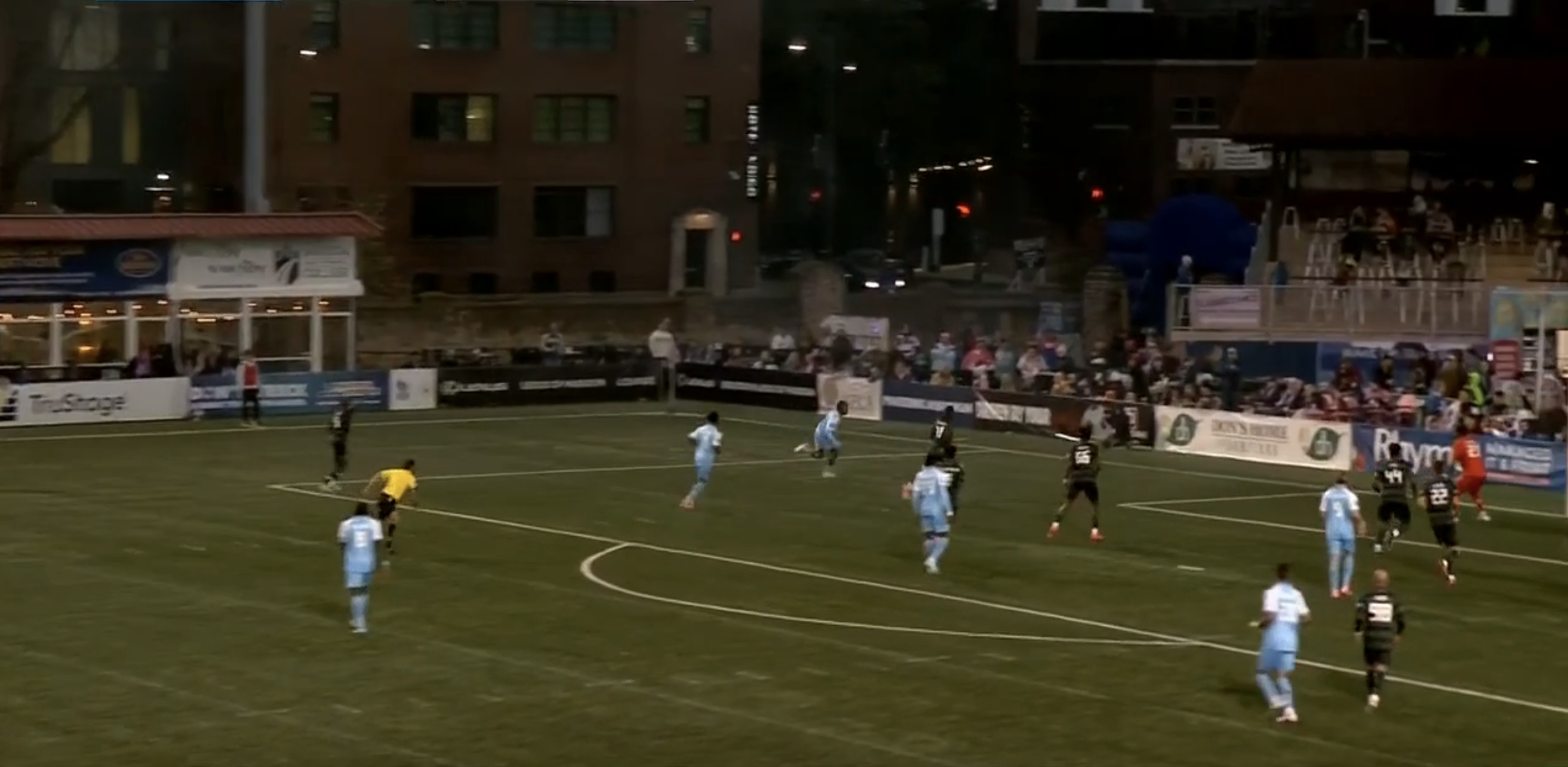
See any problems with Madison's No. 9 in the bottom right? Neither center backs – Evans or Mbacke Faye – are aware of him drifting off their backs into two yards of space. If they were able to execute the attempted cross on the left side of the box, the ball is pinging from the end line to Ryan Carmichael for a pretty wide-open chance to complete his hat trick.
This is the importance of structure. Knowing exactly where to be means you get to buy yourself an extra moment to check your shoulder, shift a step or two, or in this case take a beat to make sure you're not accidentally leaving the game's most dangerous player open while double-teaming the space that goalkeeper Kash Oladepo already had covered at his near post.
Low Block Laments
Low blocks can be useful tools in the right circumstance and when structured appropriately. Often, Portland found themselves in one instinctively, not out of tactics.
Let me explain.
When Portland get pressured heavily and often in counterattacking moments, they end up collapsing toward goal. No one directly attacks the ball carrier, nor is there an organized re-press to try to win it back quickly.
One of the tenets of the "pure" modern counterpressing scheme pioneered by Red Bull's Ralf Rangnick is the Eight Second rule. Essentially, the second the ball turns over, the entire team compresses to a small portion of the field at and around the ball to win it back. This involves a lot of sprinting to close down space and make it difficult for the opponent to find a free man to pass to. The goal is simply to win the ball back inside of eight seconds and go the other way, or to fall back into a deeper block since most of the team is already behind the ball.
This doesn't mean that every team – Portland included – should follow this rule to the letter; possession-based teams might meld this approach by tasking specific groups of players with ball swarming, or ask players to shift to parts of the field they ordinarily wouldn't be in to create advantageous overloads for after the ball is backpassed once the counterpress is successful.
Portland doesn't often do much of that - though pressing was a core value of Bobby Murphy's tactics during Year 1. These days, they'll often collapse into a larger defensive line sitting on top of Morse or Oladapo - 5 or sometimes 6 at the back, with the midfield just barely in front of them.
While this generally prevents shots from less than 15 or so yards, it allows teams to create shots from the top of the box with high regularity, and invites easily created space by quickly stepping forward or back because of Hearts of Pine's horizontal rigidity.
Take a look at one example of this happening in the 77th minute:
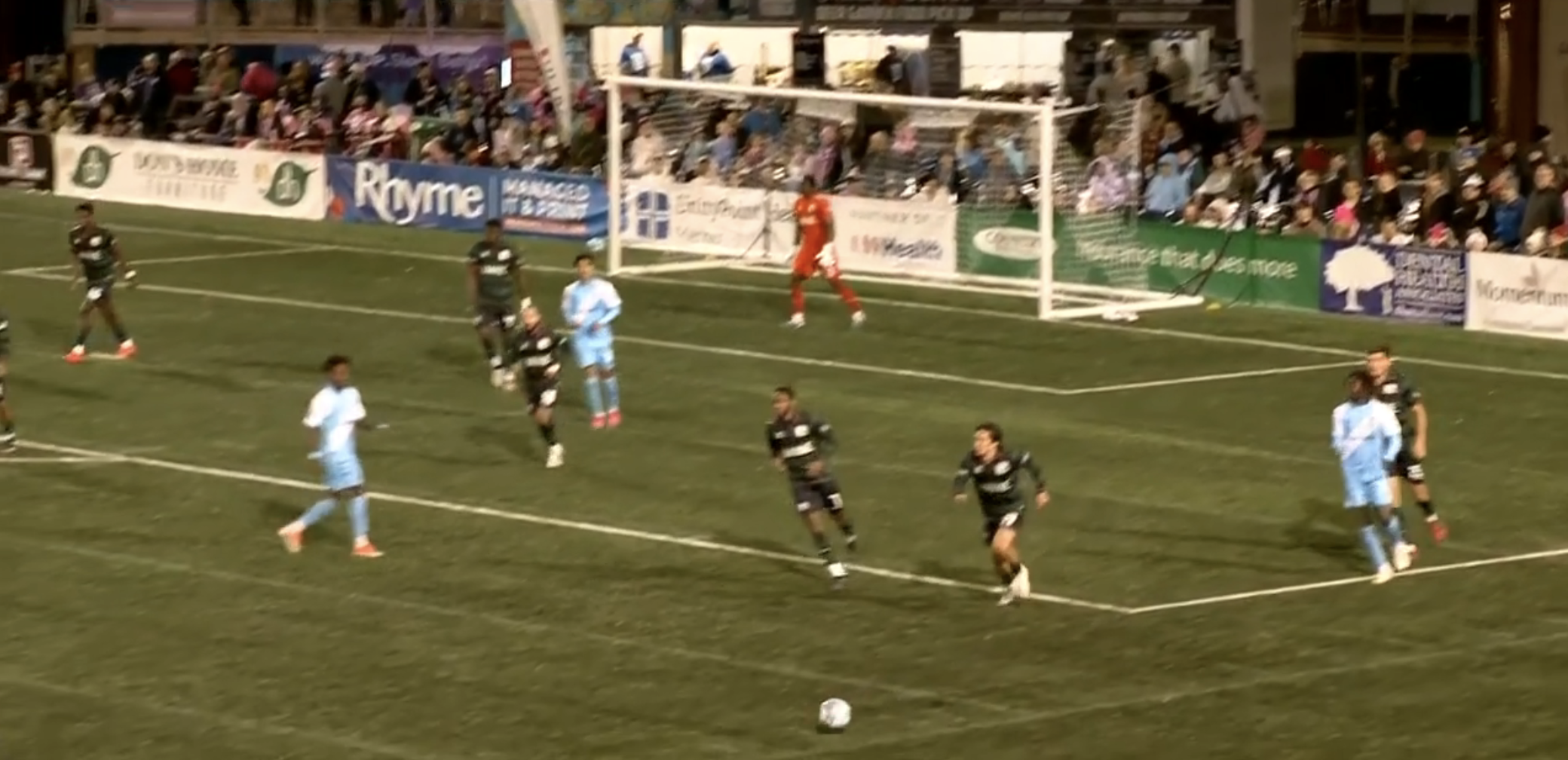
Seven of ten players behind the ball. Only three in front of it. This is the shape Portland collapsed into. The footage just before this moment shows the team collapsing into this amorphous one-or-two line defense right on top of Oladapo - horizontal rigidity.
Now let's take a look a few seconds later.
Let me pose a few questions to you. Why is Josh Drack high and wide leading the press instead of a winger? Why is Brecc Evans so far wide? Why are there multiple players not directly marking a man nor blocking a passing lane while sitting so deep?
All of this leads to Madison – among other teams in recent months – finding space near the top of the box with time to pick out shots. The longer you have to compose yourself and pick your head up, the better those opportunities become, too.
The numbers bear it out: 25 to 5 on shots, 18 to 2 inside the box. 15.6% aerial duel success rate for Portland. 28 crosses conceded.
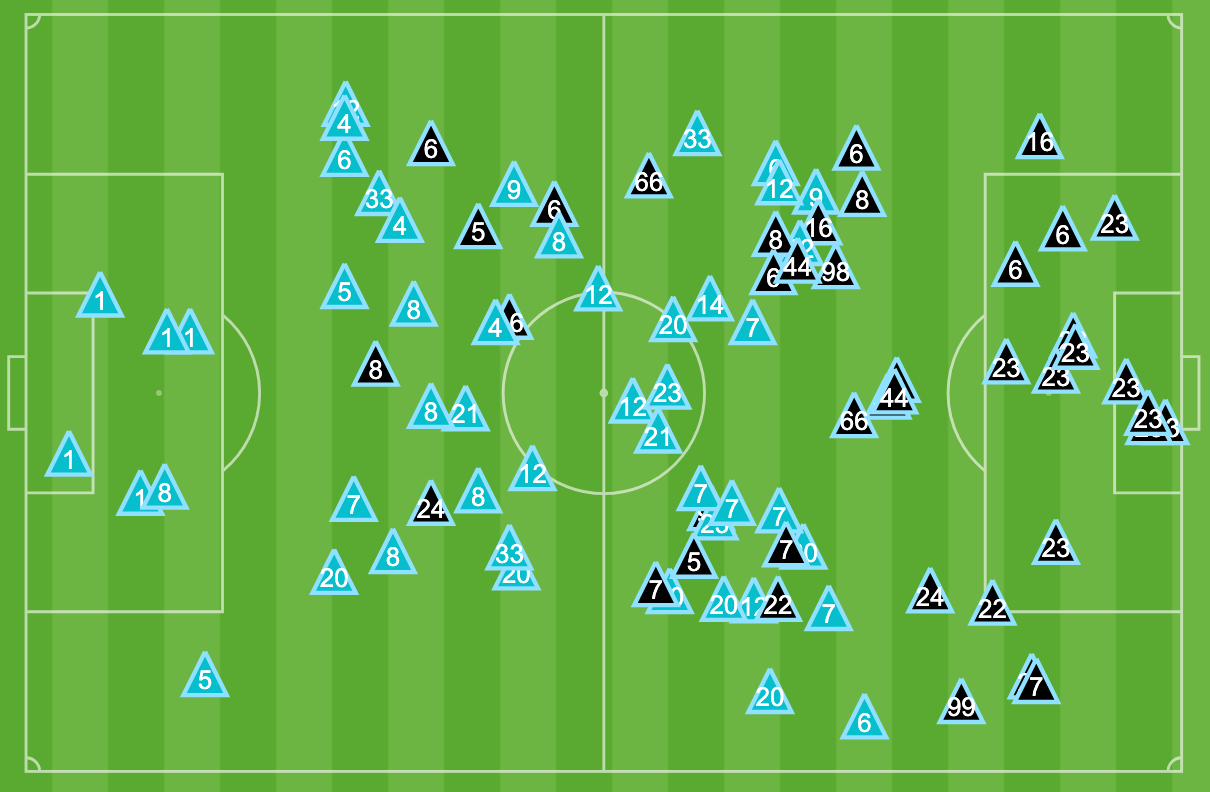
The Defensive Recoveries map tells a corroborating story. Portland in black, Madison in blue. Take a look at how much deeper Portland's average recovery is compared to Madison. This isn't just representative of where their team sits in possession, but also a function of where the team sets up blocks.
It also tells you that when Portland does regain possession, it usually has to work the ball much further up the field than their opponent. Hard to argue that it's harder to score further from the goal mouth.
The folks over at The Friggin' Soccer Show (who do fantastic work not only covering the team but having a good team doing it, can't recommend giving them a listen enough) had a good conversation discussing Hearts' set piece record and sports psychology - twelve goals conceded on the year. Factoring in really deep low-block moments that are similar to set pieces, that number likely skyrockets.
Portland aren't the tallest, meaning they need to both be more organized and more locked in than the other team to overcome that natural physical disadvantage.
Does improvement require more tactical instructions and clearer roles? A systematic or personnel shift? A psychologist to assist players in resisting a natural instinct to drop back in the face of danger but instead compress space and attack it?
These are all questions Bobby Murphy and Co. will have to consider ahead of the last game of the year and into the offseason.


