



I’m not usually one to fixate on the content of a, now weeks old, interview. Ok, that’s not true. I am on to fixate - on lots of things.
Recently, and for no particular reason (in November of 2024), I’ve been interested in the way we use language to mislead, or soften unpopular messages. More specifically, I have been thinking a lot about an answer Caleb Porter gave during an interview on 98.5 “The Sports Hub” after the season ended.
The Blazing Musket is a reader-supported publication. To receive new posts and support our work, consider becoming a paid subscriber.
New England had a historically bad year in 2024. They scored the fewest goals in the league and conceded the 3rd most goals in MLS history. With the exception of 8 weeks (5 of them coming in June/Early July), the Revs five game average was below 1.00 point-per-game for much of the year.
 Andy Judd
It was ugly.
That’s why I took particular exception to the way Caleb Porter framed his teams year in a recent interview on 98.5 The Sports Hub. The answer of interest occurs at 1:55 of this clip, but I’ve also typed it below.
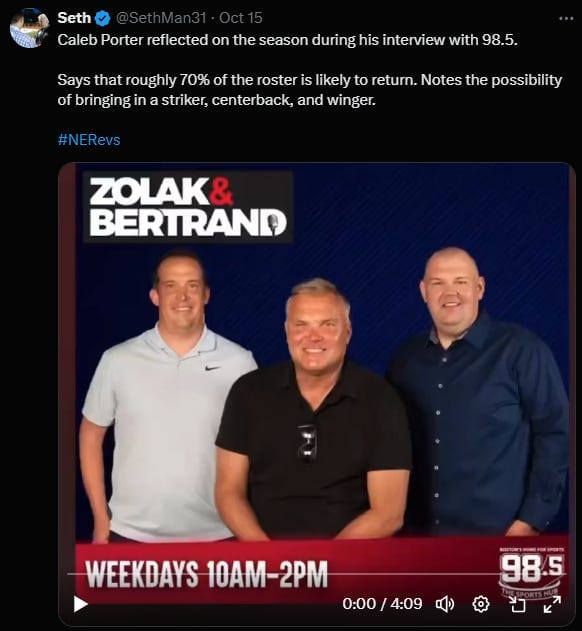
“I think, box-to-box, we’ve been pretty good, but we get chances and we don’t score. The opponent gets a chance, they score. And those are the margins.”
That sounds nice. The Revs were unlucky to miss their chances and the margins are thin. No reason to panic.
But is it true? Let’s apply a bit of fact-checking to Caleb Porter’s claim.
Claim: “We Get Chances And We Don’t Score”
Fact-Check Rating: False - Boots on Fire
Ok. Right off the bat, this is technically correct. It is undeniably true that the Revolution had at least one chance to score this season, and failed to convert. That is also true of every other team in MLS, and very likely every team to ever play the sport of soccer at any level, anywhere in the world.
Here’s an example from the Revs recent season:
It’s worth noting, that the claim above doesn’t include any sort of quantities. No mention of how many chances, or how many misses. That’s not a mistake.
Generating chances is, arguably, the point of playing soccer. And missing chances is an unavoidable, and certainly universal, side effect. No team converts 100% of their opportunities. That’s why it’s generally good to generate either a lot of chances, or very high quality chances.
We, in fact, DO have a way to attach a number to chance quality. If you’ve read my work before, or paid attention during the game broadcasts, you’ve likely heard of expected goals. xG is an advanced metric designed to predict how many goals you should have scored based on the quality and quantity of chances created.
Caleb Porter didn’t mention expected goals in his answer but it’s heavily implied that he thinks that New England created good chances (xG) and didn’t convert them into goals (G). And that fact serves as a partial explanation as to why New England struggled so much in 2024.
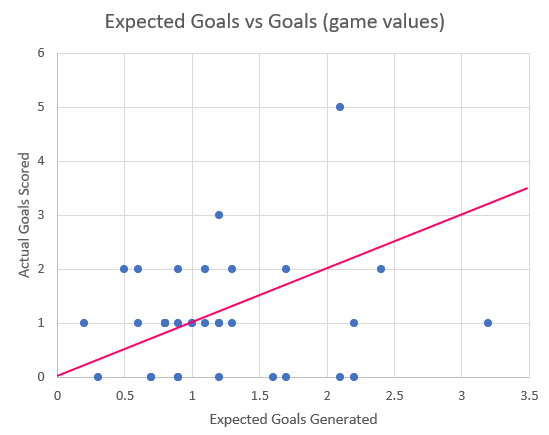
The issue with that line of thought is that it’s completely wrong. New England didn’t systematically underperform their expected goals values. At least not regularly.
Above is a scatterplot of xG vs G, with each point on the graph coming from a single game’s xG/G. The red line is a 1:1 correspondence. Any points above the red line indicate games in which the Revolution out-performed their expected goals - i.e. got more goals than they were expected to. Values below the red line indicate the scenario Caleb Porter seems to hint at; where they generated more chances than they converted on.
But there aren’t disproportionately more dots under the line, than over.
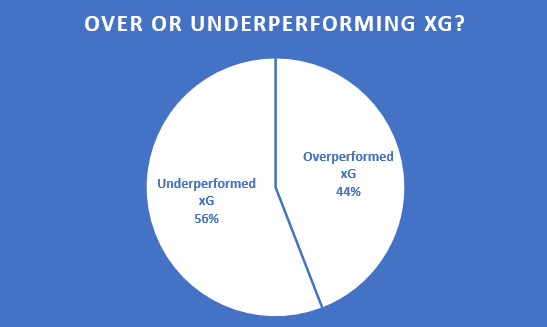
By the numbers they underperformed their expected goals about 56% of the time. Not ideal, but not the worst - especially given the sample size.
It’s clear that there’s nothing particularly unusual with how often the Revs missed their chances. So why phrase it as the vague “we get chances, we don’t score”?
Well, seemingly, that’s a good way to soften the reality of New England’s poor season and, in turn, his coaching record. It allows Porter to hand-wave poor results away as a function of discrete missed opportunities and not something more systematic.
That’s smart - because looking at it systematically: the Revs generated chances, but … not very many chances.
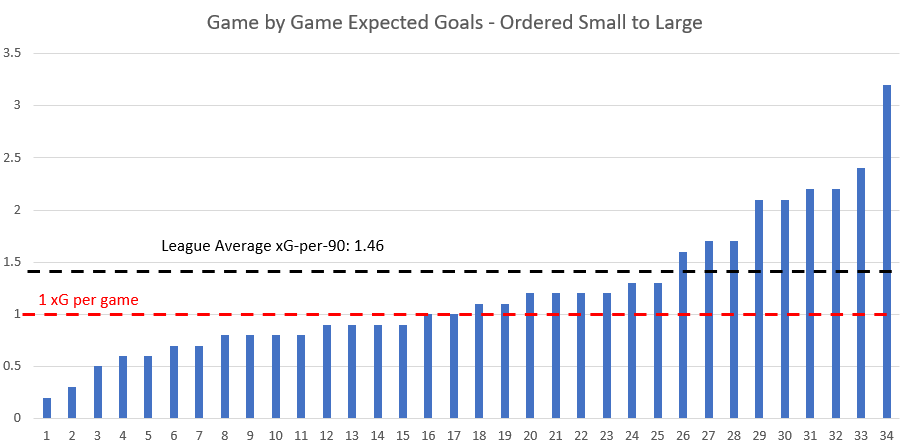
The Revs generated fewer expected goals than the league average in 25 of 34 matches. Worse than that they generated fewer than one expected goal in 15 contests on the year. They managed to create just 36.8 expected goals through the whole season, easily the worst mark in the league.
That’s the reality hidden behind Porter’s messaging.
I am rating this claim - False - “Boots on Fire” levels of false.
False both on the grounds that the Revolution generated adequate chances and on the grounds that they failed to convert on a disproportionate amount of those chances.
Claim: “The Opponent Gets A Chance, They Score”
Fact Check Rating: False - 3 Pochettinos
Once again, taking the claim at face value - of course it’s true. All MLS teams generated a chance, and all MLS teams (even the 2024 Revs) scored from a chance.
However, the purpose of what Porter says here is to equivocate the types of chances the Revs generated and the chances they conceded. In fact it’s an attempt to make it sound like the Revolution generated more than their opponents.
“We get chances [plural]” … “they get a chance [singular]”.
Uhm… Maybe he was watching a different game?
I won’t belabor this point too much. If you watched the Revs in 2024, you’re probably aware that their opponents generated many more and much better chances than New England. While it’s true that the Revolution generated the fewest expected goals in the league, it’s also true that they conceded the most expected goals in MLS (at 62.8 xGA).
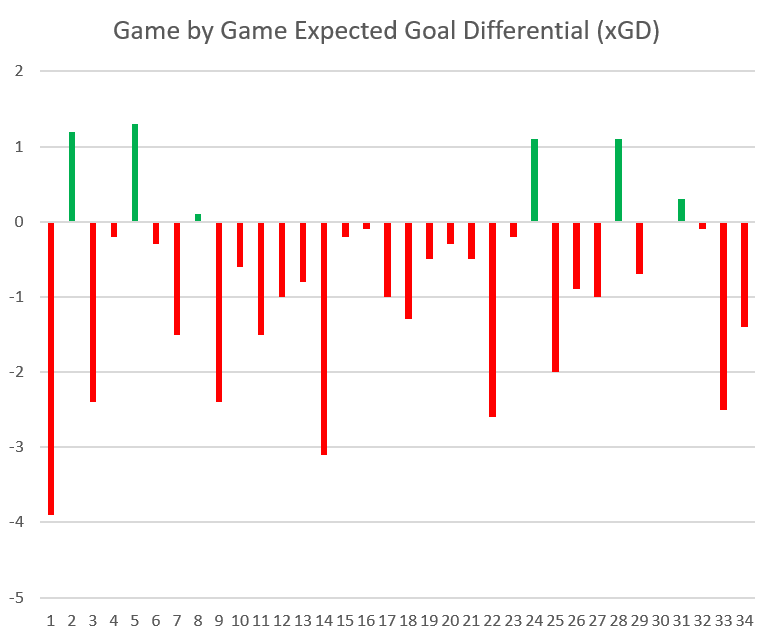
This chart shows the game-by-game expected goal differential. It will look familiar to those who read my 2024 ‘Post Mortem’. The red bars represent games in which New England’s opponents generated more chances than they were able to generate for themselves. The green bars mean the opposite.
That’s a lot of red.
This isn’t “the opponent gets a chance…”
The opponent got many chances. And good chances. And not just here-or-there, but throughout the season.
If you were to apply a reasonable interpretation to Porter’s quote above, you might think that New England’s opponents were outperforming the chances they generated. “We get chances we don’t score, the opponent gets a chance [and] they score”.
It is true that New England’s opponents outpaced their expected goals on the season. The Revs scored 7 percent more goals than expected. It is, however, not true that this is some major departure from expectations.
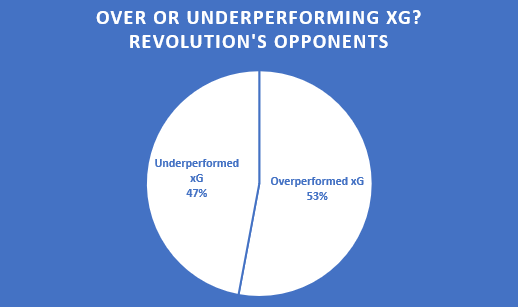
New England’s opponents out-performed their chances 53% of the time against the Revs this year. New England gave up the third highest number of goals in a single season and, based on the data, just about deserved to do so.
All of that moreso points to systematic issues in defense, whether by personnel or by coaching. It’s certainly not a matter of luck, underperformance, or discrete errors as the quote seems to suggest.
We were given the prompt “We get chances and we don’t score. The opponent gets a chance, and they score”.
I rate the claim as - False - “3 Pochettinos” worth of false.
The way in which this is phrased suggests that opponents generated fewer chances, and scored above the expected amount. Neither case is true in any significant way.


